Case Study · Business Systems & Workflow Automation
Connecting Pricing, Contracting, and Client Onboarding
How I organized reusable information across pricing decisions, agreement preparation, client communication, and the transition into active operations.
Internal Portal · Workflow Automation · PHP · JavaScript · Google Workspace
At a Glance
Recognizing the Opportunity
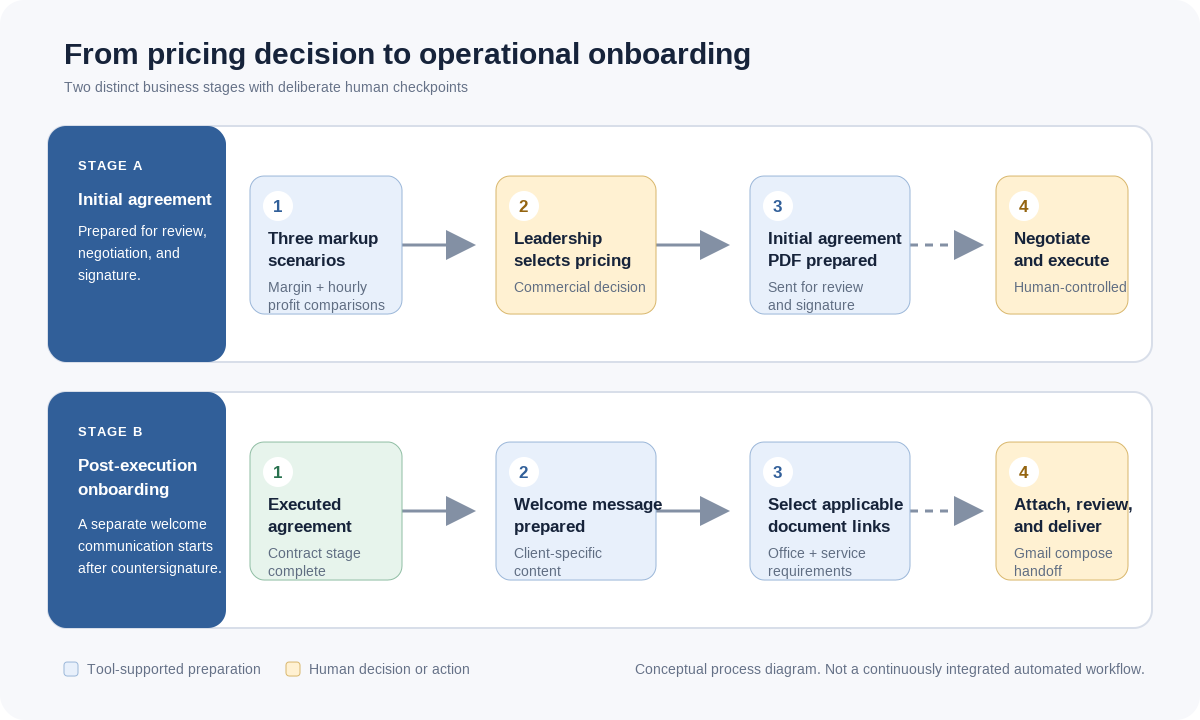
I recognized an opportunity to improve client onboarding by organizing information once and reusing it across several related business processes.
Pricing calculations lived in a spreadsheet that combined reference data with the working calculation interface. Once pricing was approved, staff still had to carry the same information into manually assembled contracts and disconnected onboarding activities. Client communication and operational setup required additional preparation after the agreement was signed.
The underlying problem was not that every step needed to be automated. It was that structured information already existed, but the business had limited ways to reuse it. I believed a relatively focused set of tools could make pricing easier to evaluate, reduce repetitive contract preparation, and create a more organized path from prospective client to active account.
Swipe horizontally to explore the illustration.
Separating the Data From the Decision
I began by separating the master pricing dataset from the interface used to calculate and compare client rates. I then built a dedicated pricing calculator within the Sustainable Staffing Internal Portal.
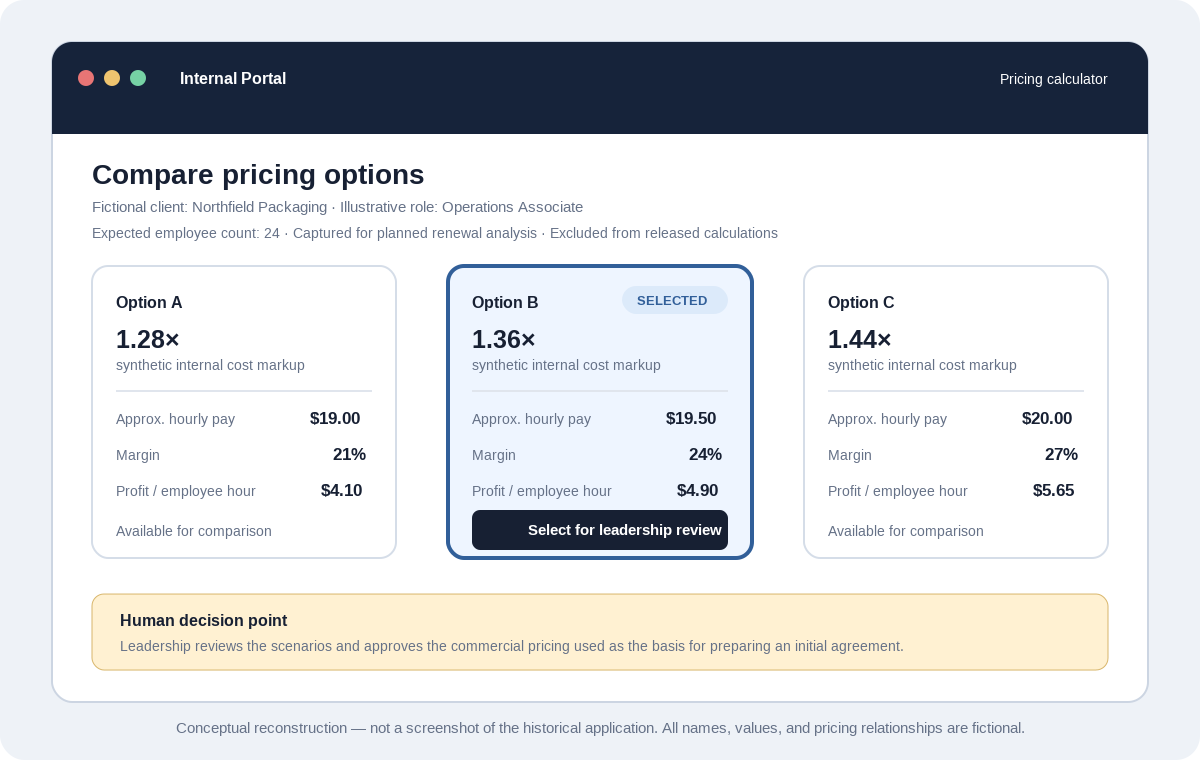
The calculator used the structured data to present three alternative internal cost-markup scenarios. Approximate hourly pay supported comparisons of margin and dollar profit per employee hour, giving company leadership a consistent way to evaluate possible pricing without working directly in the master spreadsheet.
The calculator also captured an expected employee count for a potential future renewal-analysis capability. That value was not used in the released pricing calculations, and renewal analysis was not implemented during my tenure.
The practical value was not just a different calculation screen. Separating the data from the interface made the underlying information reusable and gave the pricing process a clearer structure. The system performed the repeatable calculations, while leadership retained authority over the commercial decision.
Once an option was selected, the approved pricing provided a structured basis for preparing the initial agreement, reducing the need to reconstruct the same information from scratch.
Swipe horizontally to explore the illustration.
Turning Approved Information Into an Initial Agreement
Contract preparation was a natural extension of the pricing work.
I built an agreement-generation process that combined the approved pricing with information about the prospective client. Through a structured Portal form, the user could enter or confirm the necessary details and generate an initial staffing agreement. The resulting document could be previewed and exported as a PDF.
This initial agreement belonged to the first stage of the client relationship. It was sent to the prospective client for review and signature. Negotiation, revisions, signatures, and countersignature continued through the established human process.
Automating the initial preparation gave that process a more consistent starting point. It reduced the need to repeatedly assemble the same information while preserving the review and approval steps required to reach a fully executed agreement.
Moving From Contract Execution to Client Onboarding
The fully executed agreement served a different purpose from the initial PDF.
The initial agreement supported client review and signature. After the agreement had been negotiated, signed, and countersigned, a separate welcome and onboarding communication was prepared for the new client.
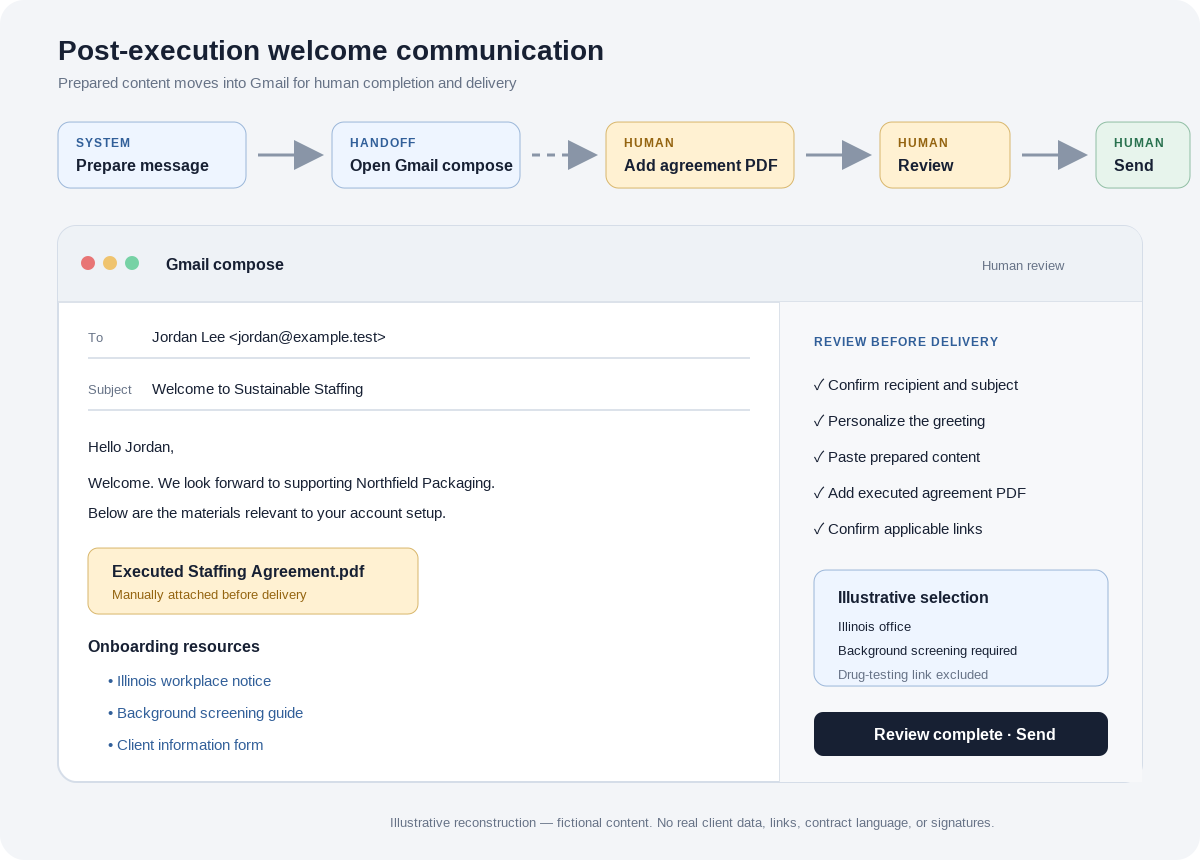
I developed tooling to prepare that communication using available client and contact information. The fully executed staffing agreement was included as a PDF attachment. Other onboarding materials were supplied as links within the message rather than as a collection of additional attachments.
Those supporting materials varied according to the client's circumstances. Applicable links depended on factors such as whether the account was associated with an Illinois or Wisconsin office and which services the client required, including background checks, drug testing, and other onboarding needs. Materials that did not apply could be left out.
This addressed a practical communication problem. Instead of starting from a generic email and manually gathering every document, the sales team received a client-specific starting point containing the relevant information and resources.
The application prepared the message and handed it off to Gmail. The representative could review the recipients and subject, paste the prepared body, attach the fully executed agreement, personalize the communication, and send it. The tooling reduced repetitive preparation without removing the final review expected for a client-facing message.
Swipe horizontally to explore the illustration.
Preserving Appropriate Access Boundaries
Client onboarding also involved information with different confidentiality requirements.
Executed agreements contained commercial terms and signatures, so they were stored in an executive-restricted Google Drive repository. Operational client information served a broader internal purpose and was organized within the company-accessible client profile.
The profile gave employees a client-centered place to find the contacts, locations, requirements, documents, and workflow connections needed to support the account. It did not replace the restricted contract repository, and the contract repository was not used as the broader team's operational workspace.
This separation allowed the process to support daily work without broadening access to confidential commercial records.
Building Toward a Larger Workflow
My broader architectural goal was to connect pricing, contracting, client communication, and operational setup through a unified onboarding workflow.
Changing business priorities prevented the components from becoming one fully integrated application. Some transitions remained manual. Although expected employee count was captured with a possible future renewal-analysis capability in mind, renewal analysis was not implemented during my tenure.
Even without complete integration, the delivered components addressed real business needs.
The separated master dataset and pricing calculator made pricing information reusable and gave leadership three consistent options to evaluate. The agreement generator used approved information to prepare the initial staffing agreement as a PDF. The communication tooling helped assemble a client-specific welcome message and the appropriate onboarding links. The final operational handoff organized client information for the employees responsible for supporting the account.
Together, these tools created a more coherent path through activities that had previously depended on disconnected preparation. Each component was useful on its own, while also contributing to the larger architectural direction.
Practical Automation Within Real Constraints
This project reinforced the value of incremental automation.
A complete architecture can provide direction, but a system does not need to reach its final form before it begins solving worthwhile problems. In this case, the larger goal was a unified onboarding workflow. Business priorities changed before every connection could be completed, but the pricing, agreement, communication, and operational components still improved important parts of the process.
The work also demonstrated the importance of choosing the right automation boundaries. Structured data, calculations, document preparation, and conditional content were strong candidates for reusable tooling. Pricing authority, contract negotiation, signatures, and final client communication remained with the people accountable for those decisions.
I look for information that can be structured and reused, identify focused opportunities where automation can remove repetitive work, and build components that remain valuable within the organization's actual constraints.
The result was not a fully automated onboarding platform. It was a practical progression of improvements that made existing information more useful and connected several important stages of the client relationship. It showed that incremental automation can deliver meaningful operational value even when the larger architectural vision is still evolving.